
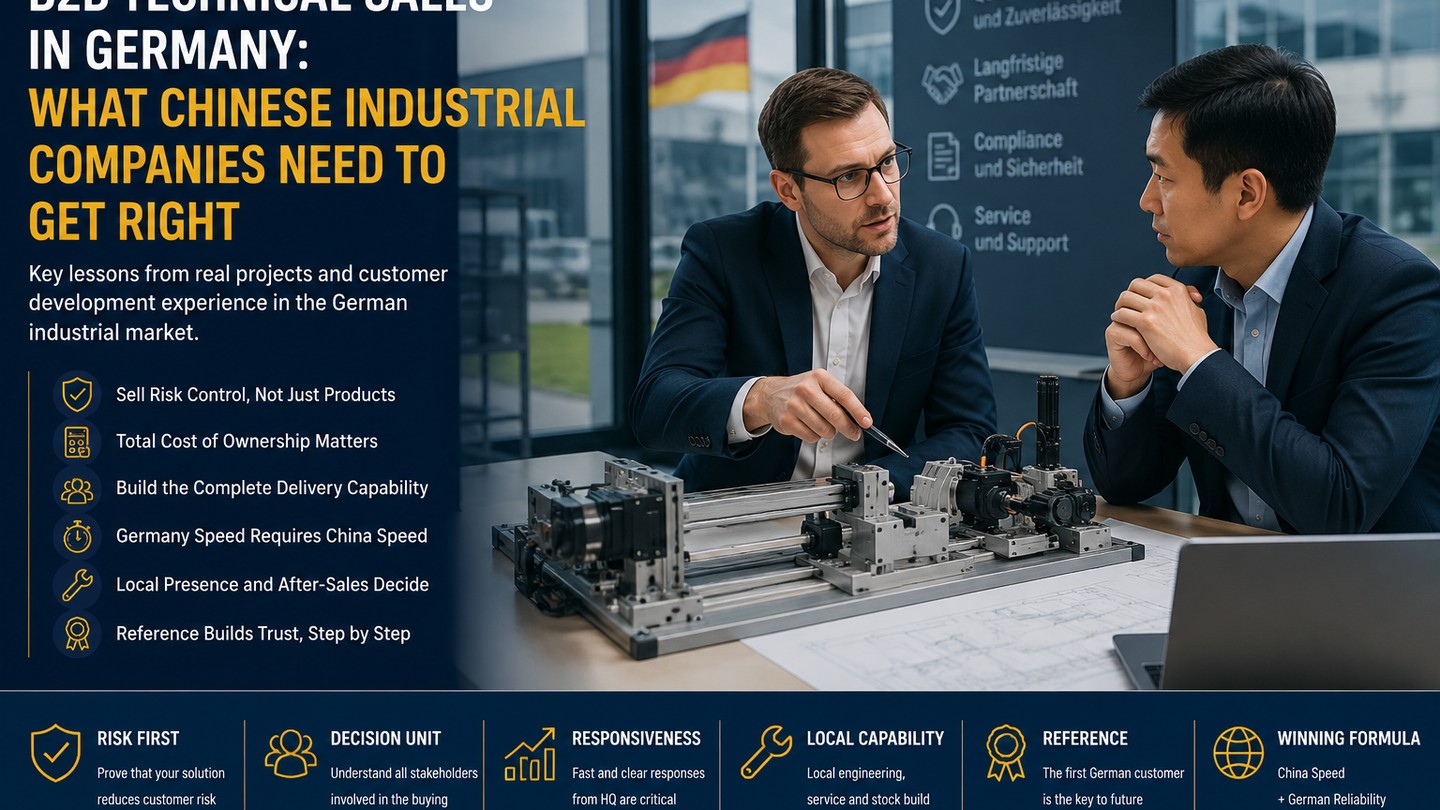
Chinese industrial companies often enter Germany with a reasonable assumption: if the product is competitive, the price is attractive and a capable salesperson is hired, sales should follow. In practice, German industrial B2B buying works differently.
1. Sell controllable risk, not only product performance
German customers assess who owns the local relationship, who responds when something fails, whether documentation is complete, how quickly spare parts arrive and whether promises made by headquarters can be executed locally. Established competitors possess accumulated trust. A new Chinese supplier must deliberately compensate for that gap.
2. Low price is not a complete value proposition
Industrial buyers consider total cost of ownership and the cost of failure. A €100,000 purchase-price advantage can become irrelevant if commissioning, interfaces, service or downtime are perceived as risky. The better sales question is not “How much cheaper can we be?” but “How do we prove that choosing us will not create unacceptable operating risk?”
3. Build a Sales–Engineering–Project–Service loop
Technical customers quickly move from presentations to interfaces, FAT/SAT, software changes, acceptance, spare parts and escalation. If every answer requires a new headquarters approval, the German salesperson becomes a messenger rather than an accountable commercial interface.
4. Headquarters response speed is part of German sales performance
Technical clarification, drawings, quotations, certifications, delivery confirmation and contract changes all require internal support. Slow headquarters response can destroy momentum even when the German salesperson has created a real opportunity. Define internal response times and decision owners.
5. “Interesting” is not pipeline evidence
Track customer commitment: real application data, engineering participation, tests, RFQs, purchasing involvement, interface discussions and supplier qualification. A useful progression is Interest → Technical Validation → Commercial Validation → Supplier Qualification → Project Decision.
6. Map the customer decision unit
Engineering, production, quality, maintenance, purchasing and management may all influence an industrial purchase. Identify the champion, technical gatekeeper, budget owner, potential blocker and final approver instead of equating one purchasing contact with the decision process.
7. The first German reference can be worth more than its margin
New suppliers face a credibility loop: no German reference makes winning the first German customer harder. Reduce adoption risk through pilots, technical validation, comparable European references, visits and stronger support for early projects. The strategic asset being built is credibility.
8. A trade fair is a node in account development
Do not measure success by business cards. Measure qualified leads, technical meetings, customer visits, RFQs and pilot opportunities 30 days later. Target accounts before the fair, book meetings, follow up individually within 48 hours and move opportunities into a disciplined CRM process.
9. The German team cannot be headquarters' translator
Local leaders must be able to tell headquarters that price is not the problem, that service credibility is missing, or that an apparent opportunity does not justify more engineering effort. Localization means allowing German market evidence to change company decisions.
10. The stronger model is China Speed + German Reliability
Chinese companies can retain engineering depth, manufacturing scale, cost efficiency and fast customization while building German customer interface, local decision-making, compliance, project coordination, service and market intelligence.
A conclusion from practical management experience
Many apparent sales problems in Germany are ultimately organization, authority, response-speed, service or execution problems. The objective is not merely to create a German sales department. It is to create enough local operating capability for the customer to believe: “This company can deliver here.”
Frequently asked questions
Should a Chinese industrial company start with direct sales or a distributor?
It depends on customer concentration, technical complexity, deal value and the need for direct market knowledge. Hybrid models are often appropriate.
Do German B2B customers care about price?
Yes, but price is one variable among reliability, technical risk, service, delivery and lifecycle cost.
Why do Chinese suppliers fall into price competition?
When customers cannot verify meaningful differences in service, reliability or execution, price becomes the easiest comparison. Build verifiable differentiation instead.
What matters most in a local technical sales role?
The ability to understand the customer's technical and commercial decision process and translate German market evidence into executable headquarters decisions.