
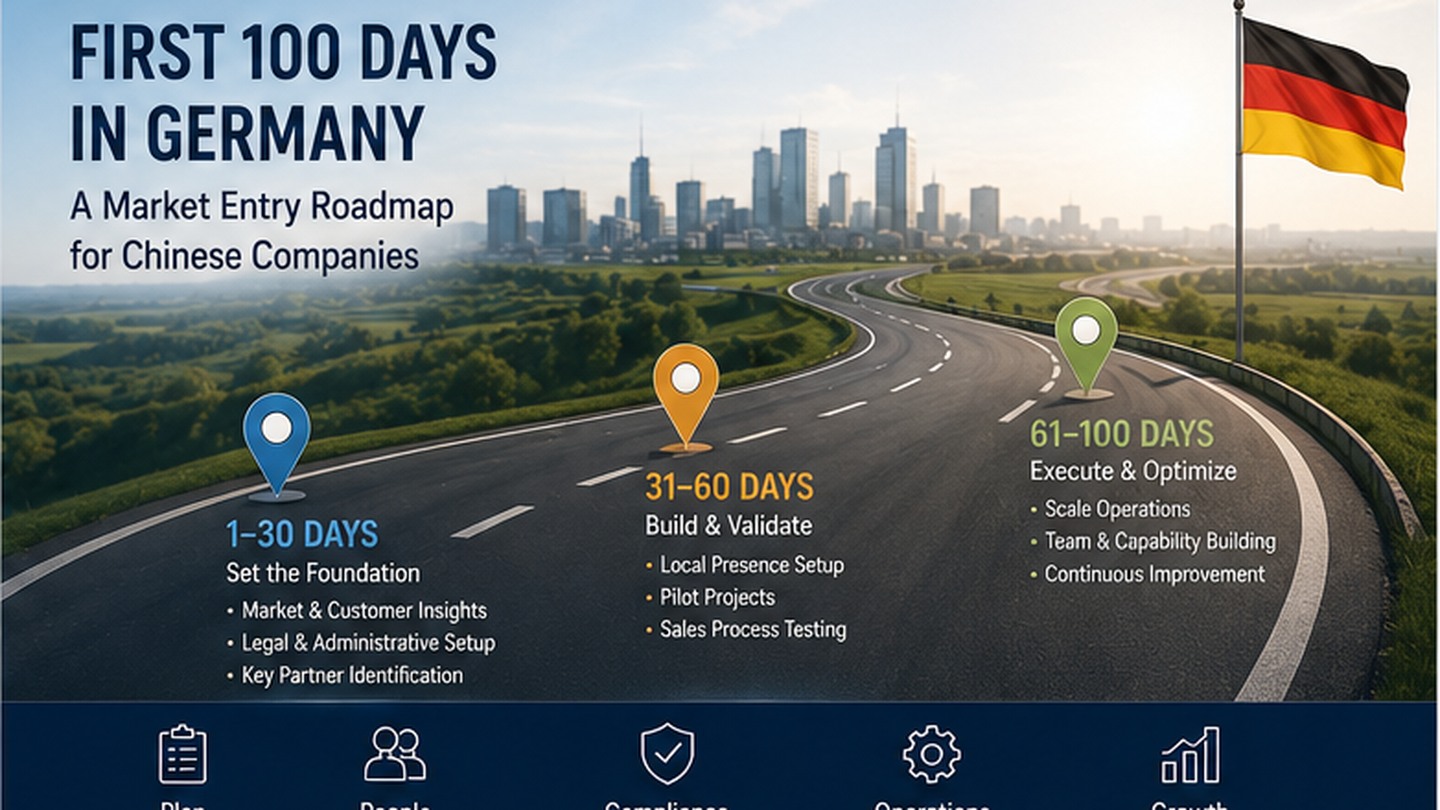
First 100 Days in Germany: A Market Entry Roadmap for Chinese Companies is designed as a practical management guide for Chinese industrial companies. It deliberately addresses a different search intent from BUSCARO’s existing articles on general Germany market entry, compliance, Chinese engineers, industrial equipment compliance and finding distributors.
1. Days 1–20: validate the market thesis
Days 1–20: validate the market thesis should be treated as a management decision rather than an isolated administrative task. For a Chinese industrial company, the German market creates a set of connected choices: who owns the customer, who carries local responsibility, what must be done locally, what can remain in China, and what evidence is required before more fixed cost is added.
The practical mistake is to optimize one dimension while ignoring the others. A structure can look inexpensive but slow customer response; a local hire can look productive but have no authority; a distributor can create coverage but block direct market learning. The better approach is to define the operating logic first and then select the legal, commercial and organizational tools that support it.
Management should therefore document the assumption behind the decision, the owner, the measurable result expected within the next 60–90 days and the trigger for escalation or redesign. This converts market entry from a sequence of ad-hoc reactions into an evidence-based operating system.
2. Days 21–35: define the German operating model
Days 21–35: define the German operating model should be treated as a management decision rather than an isolated administrative task. For a Chinese industrial company, the German market creates a set of connected choices: who owns the customer, who carries local responsibility, what must be done locally, what can remain in China, and what evidence is required before more fixed cost is added.
The practical mistake is to optimize one dimension while ignoring the others. A structure can look inexpensive but slow customer response; a local hire can look productive but have no authority; a distributor can create coverage but block direct market learning. The better approach is to define the operating logic first and then select the legal, commercial and organizational tools that support it.
Management should therefore document the assumption behind the decision, the owner, the measurable result expected within the next 60–90 days and the trigger for escalation or redesign. This converts market entry from a sequence of ad-hoc reactions into an evidence-based operating system.
3. Days 36–50: build a target-account and channel map
Days 36–50: build a target-account and channel map should be treated as a management decision rather than an isolated administrative task. For a Chinese industrial company, the German market creates a set of connected choices: who owns the customer, who carries local responsibility, what must be done locally, what can remain in China, and what evidence is required before more fixed cost is added.
The practical mistake is to optimize one dimension while ignoring the others. A structure can look inexpensive but slow customer response; a local hire can look productive but have no authority; a distributor can create coverage but block direct market learning. The better approach is to define the operating logic first and then select the legal, commercial and organizational tools that support it.
Management should therefore document the assumption behind the decision, the owner, the measurable result expected within the next 60–90 days and the trigger for escalation or redesign. This converts market entry from a sequence of ad-hoc reactions into an evidence-based operating system.
4. Days 51–65: close the critical compliance interfaces
Days 51–65: close the critical compliance interfaces should be treated as a management decision rather than an isolated administrative task. For a Chinese industrial company, the German market creates a set of connected choices: who owns the customer, who carries local responsibility, what must be done locally, what can remain in China, and what evidence is required before more fixed cost is added.
The practical mistake is to optimize one dimension while ignoring the others. A structure can look inexpensive but slow customer response; a local hire can look productive but have no authority; a distributor can create coverage but block direct market learning. The better approach is to define the operating logic first and then select the legal, commercial and organizational tools that support it.
Management should therefore document the assumption behind the decision, the owner, the measurable result expected within the next 60–90 days and the trigger for escalation or redesign. This converts market entry from a sequence of ad-hoc reactions into an evidence-based operating system.
5. Days 66–80: run real customer-development experiments
Days 66–80: run real customer-development experiments should be treated as a management decision rather than an isolated administrative task. For a Chinese industrial company, the German market creates a set of connected choices: who owns the customer, who carries local responsibility, what must be done locally, what can remain in China, and what evidence is required before more fixed cost is added.
The practical mistake is to optimize one dimension while ignoring the others. A structure can look inexpensive but slow customer response; a local hire can look productive but have no authority; a distributor can create coverage but block direct market learning. The better approach is to define the operating logic first and then select the legal, commercial and organizational tools that support it.
Management should therefore document the assumption behind the decision, the owner, the measurable result expected within the next 60–90 days and the trigger for escalation or redesign. This converts market entry from a sequence of ad-hoc reactions into an evidence-based operating system.
6. Days 81–90: design service and execution readiness
Days 81–90: design service and execution readiness should be treated as a management decision rather than an isolated administrative task. For a Chinese industrial company, the German market creates a set of connected choices: who owns the customer, who carries local responsibility, what must be done locally, what can remain in China, and what evidence is required before more fixed cost is added.
The practical mistake is to optimize one dimension while ignoring the others. A structure can look inexpensive but slow customer response; a local hire can look productive but have no authority; a distributor can create coverage but block direct market learning. The better approach is to define the operating logic first and then select the legal, commercial and organizational tools that support it.
Management should therefore document the assumption behind the decision, the owner, the measurable result expected within the next 60–90 days and the trigger for escalation or redesign. This converts market entry from a sequence of ad-hoc reactions into an evidence-based operating system.
7. Days 91–100: make the first scale/no-scale decision
Days 91–100: make the first scale/no-scale decision should be treated as a management decision rather than an isolated administrative task. For a Chinese industrial company, the German market creates a set of connected choices: who owns the customer, who carries local responsibility, what must be done locally, what can remain in China, and what evidence is required before more fixed cost is added.
The practical mistake is to optimize one dimension while ignoring the others. A structure can look inexpensive but slow customer response; a local hire can look productive but have no authority; a distributor can create coverage but block direct market learning. The better approach is to define the operating logic first and then select the legal, commercial and organizational tools that support it.
Management should therefore document the assumption behind the decision, the owner, the measurable result expected within the next 60–90 days and the trigger for escalation or redesign. This converts market entry from a sequence of ad-hoc reactions into an evidence-based operating system.
8. What management should have after 100 days
What management should have after 100 days should be treated as a management decision rather than an isolated administrative task. For a Chinese industrial company, the German market creates a set of connected choices: who owns the customer, who carries local responsibility, what must be done locally, what can remain in China, and what evidence is required before more fixed cost is added.
The practical mistake is to optimize one dimension while ignoring the others. A structure can look inexpensive but slow customer response; a local hire can look productive but have no authority; a distributor can create coverage but block direct market learning. The better approach is to define the operating logic first and then select the legal, commercial and organizational tools that support it.
Management should therefore document the assumption behind the decision, the owner, the measurable result expected within the next 60–90 days and the trigger for escalation or redesign. This converts market entry from a sequence of ad-hoc reactions into an evidence-based operating system.
Practical scenario
A Chinese industrial supplier has initial German customer interest but limited local structure. Headquarters wants to accelerate immediately. Instead of committing simultaneously to people, entity, channel and service cost, management sequences the decisions: validate customer demand, define the operating bottleneck, close the relevant compliance interface, then release the next investment. The result is not slower market entry; it is lower-cost learning and fewer irreversible mistakes.
Frequently asked questions
Can Germany market entry be validated in 100 days?
You will not build a mature business in 100 days, but you can generate enough evidence to improve or reject major assumptions about customers, channels, operating model and required investment.
Should we establish a company during the first 100 days?
Only if the planned activities and triggers justify it. Entity formation should not substitute for market validation.
What is the most important output?
A fact-based decision about where to invest next, supported by customer evidence, operating requirements and known risks.
What should not be used as proof of traction?
Trade-fair visitors, generic distributor interest, meetings without next steps and internal activity volume are weak substitutes for qualified customer evidence.
Final management point
The objective is not to build the largest German organization quickly. It is to build the smallest operating model that can produce reliable customer evidence, execute professionally and scale without repeatedly redesigning the business.